
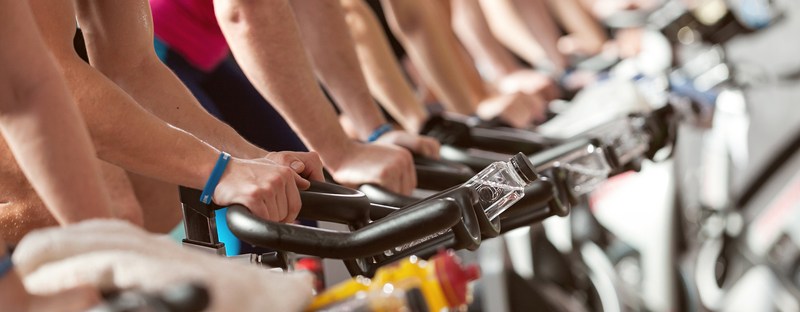
There is more to indoor cycling than just jumping on the bike and pedaling. It is a fantastic workout! I can take a class through a great leg workout, which includes those glutes, as well as a cardio workout. However, there are several things to consider prior to just jumping on the bike!
Posture and Proper Set-up Prior to Starting a Ride
Align your upper body properly to start with on the bike. Your spine should be straight, not rounded or slumped (make sure your handlebars are high enough so you don’t feel neck or back strain). Your shoulders should be relaxed and down (meaning: they should not be at your ears). Keep a slight bend in your elbows as you ride and keep your elbows in line with your wrists and your knees (no chicken-winging allowed). If you are good at angles, then aim for about 15 degrees of elbow bend. Try not to bend your wrists too much, to avoid placing unnecessary strain on them, and don’t grip the handlebars too tightly.
The placement of your bottom should be proper as well. This will help that soreness you may experience at the first couple of classes. Place your butt on the widest part of the saddle. Hinge forward at the hips and engage your abdominal muscles as you reach for the handlebars. Your knees should be aligned with your hips and your feet, whether you’re riding in a seated or in a standing position; if they flare out to the side, your seat position may need to be adjusted. If your butt is uncomfortable or sore after your workout, your positioning may be incorrect. Ask your instructor for some assistance before class if you are having issues. If you feel pain in the back of your knee, then you may need to lower the seat. If you feel pain the front of your knee, then consider raising the seat. The knee should have a 5-degree bend when the leg is fully extended down.
During Your Ride
Keep your weight on the pedals. That means stabilizing your weight in your hips so that your knees stay over the center of the pedals. Don’t lean on the handlebars when you’re seated or standing; off-loading your weight this way cheats you of some of the benefits you’d get from maintaining an upright posture and it places excessive stress on the wrists and forearms. (When you’re in a standing position, you should feel the nose of the saddle brushing against the back of your upper thighs.) Also, avoid using hand position three while riding in the saddle—a taboo move! If your instructor does it, then let them, but I wouldn’t do it!
Keep your feet flat. It’s a mistake to point your toes as you pedal because this engages the wrong muscles. Instead, press through each pedal stroke with a flat foot, driving from the ball of your foot, to reduce pressure on your knees and strain on your quads. Similarly, pull up from your knees and toes on the upstroke. This will engage the hamstrings and glutes for a nice leg workout. It is more efficient way to use your muscles too.
Hold your head up. If you let your head flop or fall forward as you ride, you’ll set yourself up for neck strain—and partially impair the flow of blood and oxygen to your head, which can cause lightheadedness or dizziness. Keeping your head in line with your neck and spine helps ensure proper breathing and a steady flow of oxygen to your brain, which can help you feel good and maximize your performance. An indoor cycling class is hard enough without increasing your chances of feeling winded unnecessarily. And I can’t stress enough – lose grip on the handle bars…..of you are sore in the forearms, upper body the next day, chances are you gripped the handle bars too tight.
After You Ride
Make sure to keep spinning the legs for 1-2 minutes to slow down the heart rate properly. If you wear biking shoes, be sure to unclip them while standing, so you don’t put unnecessary pressure on your hips and knees. Then take 4-6 minutes (I make my class do a full song) to stretch the upper and lower body. Give your major muscle groups a good stretch after class.
 Healthy, Fit, & Busy - OH MY