
As a Certified Athletic Trainer and a Certified Physician Assistant in Orthopedics, I get asked a lot of questions about the shoulders. It is common for me to hear someone say, “I can’t do a bench press anymore because I have bad shoulders.” Is this you?
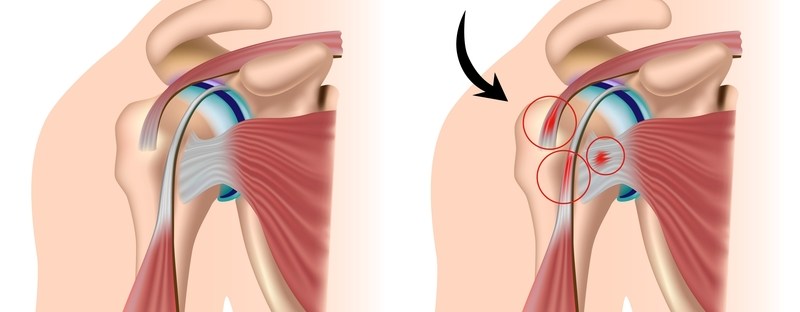
Rotator cuff impingement syndrome (RCIS) is a multifactorial disease that can lead to functional limitations and an inability to participate in work, leisure, and sporting activities. This syndrome can be caused by many factors, such as weakness of the rotator cuff and periscapular muscles, decreased pectoral and rotator cuff muscle flexibility, abnormal motion patterns, extrinsic factors (eg, vibration exposure, use of hand tools, workstation height), and trauma.
Well, guess what?? If you want those lovely shoulder muscles to have muscle definition then you have to have a strong rotator cuff!
What is the Rotator Cuff Muscle Group?
The rotator cuff is a group of four muscles that come together as tendons to form a covering around the head of the humerus. The rotator cuff attaches the humerus to the shoulder blade and helps to lift and rotate your arm.1 Basically, the rotator cuff helps to keep your arm in the shoulder joint properly.
How Do You Properly Strengthen the Rotator Cuff?
With Resistance Bands at Home: Attach light to medium resistance tubing (lighter than you would think to be honest) to a door hinge, then stand with your left side to it, grasping the handle of the tubing with your right hand. Bend right arm at a 45-degree angle to your side (your elbow is at your hip and your forearm is at a 90-degree angle in a handshake position), then rotate your arm at the elbow, pulling the tubing out towards the right side without pulling your upper arm away from your body—like a door opening on a hinge. Next, stand with your right side towards the door hinge. With your right arm bent at a 45-degree angle next to your side, grasp the handle of the tubing with your right hand and rotate your arm at the elbow, pulling the handle in towards the center of your body. Repeat 10 to 12 times on each side, alternating sides for each set. Figure Below 1
With Dumbbells at Home/Gym: Internal Rotation: Hold a dumbbell in one hand (again lighter weight, 2-5 lbs is sufficient to start). Lie on a bench close to edge on side with dumbbell in hand. Position elbow on edge of bench against side of body with elbow bent approximately 90°. Position legs on bench for support. While maintaining 90° bend in elbow, lower dumbbell away from body until slight stretch is felt in shoulder. Lift dumbbell toward body by internally rotating shoulder until forearm is across belly. Continue with opposite arm. External Rotation: Next, stand or sit with dumbbell positioned out to side of head; bend elbow, shoulder height with dumbbell above elbow. Then lower dumbbell forward by rotating shoulder. Return and repeat. Continue with opposite arm. Remember, throughout the movement, keep bent elbow (approximately 90°) out to side, shoulder height. Figure Below 2
References:
- Armstrong, A. D., & Athwal, G. (n.d.). Our knowledge of orthopaedics. Your best health. Retrieved from https://orthoinfo.aaos.org/en/diseases–conditions/rotator-cuff-tears/
- Summit Medical Group Web Site. (n.d.). Retrieved December 1, 2018, from https://www.summitmedicalgroup.com/library/adult_health/sma_rotator_cuff_injury_exercises/#&gid=1&pid=1
- Rotator Cuff Exercises. (n.d.). Retrieved December 1, 2018, from https://www.google.com/search?biw=1280&bih=561&tbm=isch&sa=1&ei=TR4DXMb0KoSIgge_m6hI&q=dumbbell external rotation and internal rotation &oq=dumbbell external rotation and internal rotation &gs_l=img.3…36101.39985..40413…0.0..0.79.1133.20……1….1..gws-wiz-img…….0i30j0i5i30j0i8i30j35i39.l11W_1CkHnk#imgrc=4CCnZjzNxI2-BM:
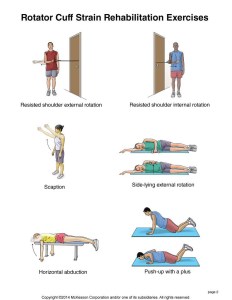 Figure 1
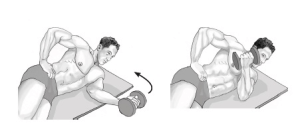 Figure 2
 Healthy, Fit, & Busy - OH MY