I have recently started to train for my StrongFirst
Kettlebell Certification with an instructor and I hear her constantly tell me
about my “biomechanical breathing” with each exercise. I have been teaching
runners for several years, all distances, and one of the early on lectures I
give to them is “find a beat with your feet when you run, using your breathing
pattern.” I am sure that all my students recall this lecture and running class.
The basic premise of breathing should feel like the following:
- Always Exhale on Exertion
- Always Inhale on Relaxation
During exercise, two of the important organs of the body
come into action: the heart and the lungs. The lungs bring oxygen into the
body, to provide energy, and remove carbon dioxide, the waste product created
when you produce energy. The heart pumps the oxygen to the muscles that are
doing the exercise. When you exercise and your muscles work harder, your body
uses more oxygen and produces more carbon dioxide. To offset this extra demand,
your breathing has to increase from about 15 times a minute (12 liters of air)
when you are resting, up to about 40–60 times a minute (100 liters of air)
during exercise. Your circulation will speed up to take the oxygen to the
muscles so that they can keep moving. The diaphragm is a dome-shaped muscle
beneath the lungs. When you inhale, it flattens and moves downward, pressing
against the abdominal organs so the lungs can expand. This gives you the best “bang
for your breath” and it is called, diaphragmatic breathing. If you were to
place one hand on your stomach and another on your chest. The majority of the
breathing motion should be felt near the stomach, not the upper chest, during
everyday life and especially during exercise.
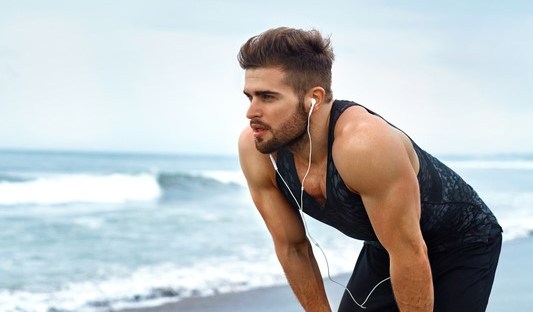
Breathing When You Run
I teach a very simple way to find what is comfortable for you, but reminding yourself to breath. When you begin running, many times you can hear your feet make a beat (ie: Stomp, Stomp, or Stomp-Shuffle, Stomp, etc,) and then once you hear what your feet sound like when you are starting out, match your breathing pattern to that beat with your feet. For example, I do the following, right leg land-breath out shallow, left leg land – breath out shallow, right leg land – long breath in, left leg land – still breathing in….sounds complicated perhaps, but I take one breath for every two foot strikes, which is called 2:2 rhythm.
- Synchronizing the breath to running cadence will
keep the organs from putting unnecessary pressure on the diaphragm, which can
impede breathing
Nose or Mouth?
There are studies that support both but what you should
really do is teste it out and see what works best for you. Some people have small
nasal passages, with enlarged turbinates within the nasal passage, making it
difficult to breathe through the nose only. Other people have no issues
breathing through the nose, so they can keep their mouth closed. My preference
is to breath in my nose and out my mouth. Just make sure you are breathing out
on exertion and in on relaxation.
Quick
Points
- Breathing in through the nose can also help warm
the air entering the lungs
- If cold weather and you can’t breathe well
through your nose, stick the tip of your tongue to the top of your palate and
allow the air to move around the tongue to help humidify the air and reduce the
‘burn in your lungs”
- Just BREATHE 😊

 Healthy, Fit, & Busy - OH MY