Injury Prevention

Achilles Tendonitis

What is Achilles Tendonitis?

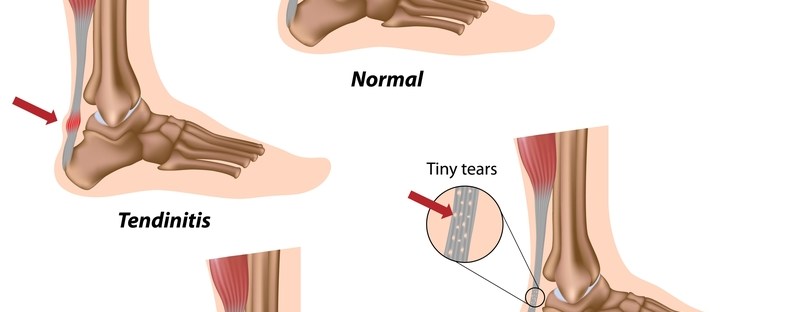
Inflammation of the Achilles Tendon which connects the two major calf muscles to the back of the heel bone. Under too much stress the tendon tightens up and is forced to work too hard and, thus, becomes inflamed. The symptoms you experience may be pain along the back of the tendon- usually close to the heel- limited ankle flexibility, a lumpy build-up of scar tissue on the tendon.

Causes?

There are several things that can cause Achilles Tendonitis during your training. The following would/could contribute to the injury:

  1. Tight calf muscles
  2. Inflexible running shoes
  3. Uncorrected overpronation
  4. Lots of hill running
  5. Over-training too quickly

Treatment

In order to combat the pain and train properly, treating the cause of the problem is important, just like any other injury. The following can be tried one at a time to find the true culprit!

  1. Decrease mileage
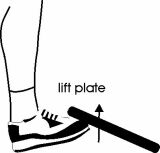
  2. Heel lift in the shoe
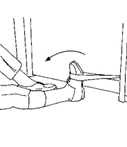
  3. Stretching properly
  4. Better shock absorption in the shoe, and/or a shoe to correct the overpronation (obtain biomechanical analysis on a treadmill at a specialty running shoe store that offers to start)
  5. An anti-inflammatory (ice, ibuprofen) (relieves and/or masks the pain so start with the above first and foremost)

Exercises for Achilles Tendonitis
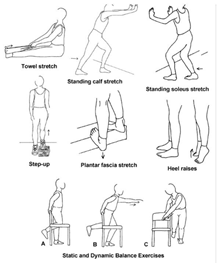
Do 3 sets of each for 20-30 sec hold on the stretch and balance
Injury Prevention

Shin Splints

What is Shin Splints?

It is inflammation of the muscle attachments and interosseous membranes of the tibia (shin bone) on the front of the lower leg. The symptoms you experience is soreness along the inside of the shin, pain at the beginning of the run, gets better during the run, sore afterwards.

Causes?

There are several things that can cause shin splints. The following would/could contribute to the injury:

  1. Overtraining
  2. Overpronation of the feet
  3. Weak Tibialis Anterior (front of shin)
  4. Old shoes
  5. Running on concrete/asphalt
  6. Tight Achilles tendon

Treatment

In order to combat the pain and train properly, treating the cause of the problem is important. Ou may have to try multiple modalities until you find the culprit!

  1. Strengthening exercises for anterior lower leg muscles (see Exercises Below)
  2. Footwear to correct overpronation, better shock absorption
  3. Run on softer surfaces,
  4. An anti-inflammatory, ice
  5. Stretching of the calf muscle and Achilles Tendon

Exercises to Strengthen Those Muscles

Do these 3 sets, light weight or resistance band, for 12-15reps only; 2-3 times a week

OR

You can walk on your heels around the house for 1 minute at a time 2-3 times a week as well to strengthen the anterior tibialis muscle

Injury Prevention

RUNNING INJURIES: The Big 5

There have been several times in the past few years (not in my 20s) that running injuries have slowed my training. I have always been on top of my shoe wear but other things can cause injury. All of the “big 5” most common running injuries are overuse injuries. The most common running injuries we see is typically the following: Achilles Tendonitis, Plantar Fasciitis, Iliotibial Band Syndrome, Shin Splints, and Patellofemoral Pain Syndrome

They can be prevented through the following:

  • Ease into increasing- Don’t increase your weekly mileage by more than 10% a week. This allows the body to adapt to new training levels.
  • Allow for rest- Your body needs time to recover. This rest phase is actually when our muscles get stronger. Not allowing for enough rest leads to continual muscle breakdown.
  • Softer is better! If you are preparing for a 5K or other race there is no substitute for outdoor running. However, constantly pounding on concrete leads to
  • increased stress on the muscles and joints and compounds the risk for chronic tissue trauma. The more you can run on the asphalt (5 times softer than
  • concrete), packed dirt, or gravel, the better. Also, throwing in a couple of treadmill runs or track workouts a week is a nice way to give your body a break from the impact.
  • Running too much uphill or downhill can lead to various overuse strains such as Achilles tendonitis (uphill) or extra stress in the knees (downhill). If you add a hill workout to your schedule make sure you ease into it and stretch your calves really well afterwards. On the week you add hills DO NOT also add mileage. In the same vein, if you add a speed workout do not also increase mileage. Make sure you are comfortably sustaining 15 miles a week before adding any “quality” workout.
  • Shoes make the runner- Have a professional do a gait analysis to make sure you are getting the right amount of support and fit for your foot type. Running shoes last between 350-450 miles depending on running style, weight, and the surfaces on which you run.