
Exercise

Breathing 101: Running and Beyond

I have recently started to train for my StrongFirst Kettlebell Certification with an instructor and I hear her constantly tell me about my “biomechanical breathing” with each exercise. I have been teaching runners for several years, all distances, and one of the early on lectures I give to them is “find a beat with your feet when you run, using your breathing pattern.” I am sure that all my students recall this lecture and running class. The basic premise of breathing should feel like the following:

  • Always Exhale on Exertion
  • Always Inhale on Relaxation

During exercise, two of the important organs of the body come into action: the heart and the lungs. The lungs bring oxygen into the body, to provide energy, and remove carbon dioxide, the waste product created when you produce energy. The heart pumps the oxygen to the muscles that are doing the exercise. When you exercise and your muscles work harder, your body uses more oxygen and produces more carbon dioxide. To offset this extra demand, your breathing has to increase from about 15 times a minute (12 liters of air) when you are resting, up to about 40–60 times a minute (100 liters of air) during exercise. Your circulation will speed up to take the oxygen to the muscles so that they can keep moving. The diaphragm is a dome-shaped muscle beneath the lungs. When you inhale, it flattens and moves downward, pressing against the abdominal organs so the lungs can expand. This gives you the best “bang for your breath” and it is called, diaphragmatic breathing. If you were to place one hand on your stomach and another on your chest. The majority of the breathing motion should be felt near the stomach, not the upper chest, during everyday life and especially during exercise.

Breathing When You Run

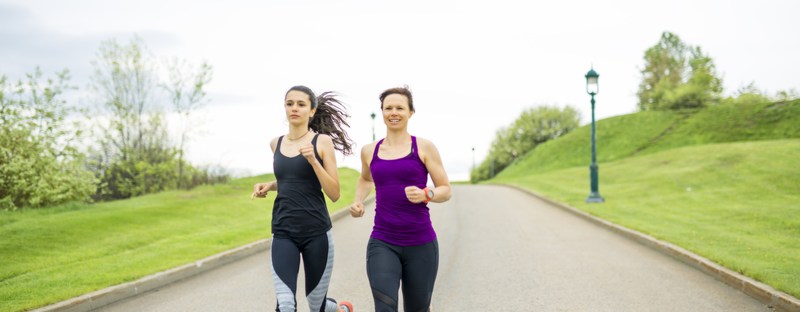
I teach a very simple way to find what is comfortable for you, but reminding yourself to breath. When you begin running, many times you can hear your feet make a beat (ie: Stomp, Stomp, or Stomp-Shuffle, Stomp, etc,) and then once you hear what your feet sound like when you are starting out, match your breathing pattern to that beat with your feet. For example, I do the following, right leg land-breath out shallow, left leg land – breath out shallow, right leg land – long breath in, left leg land – still breathing in….sounds complicated perhaps, but I take one breath for every two foot strikes, which is called 2:2 rhythm.

  • Synchronizing the breath to running cadence will keep the organs from putting unnecessary pressure on the diaphragm, which can impede breathing

Nose or Mouth?

There are studies that support both but what you should really do is teste it out and see what works best for you. Some people have small nasal passages, with enlarged turbinates within the nasal passage, making it difficult to breathe through the nose only. Other people have no issues breathing through the nose, so they can keep their mouth closed. My preference is to breath in my nose and out my mouth. Just make sure you are breathing out on exertion and in on relaxation.

              Quick Points

  • Breathing in through the nose can also help warm the air entering the lungs
  • If cold weather and you can’t breathe well through your nose, stick the tip of your tongue to the top of your palate and allow the air to move around the tongue to help humidify the air and reduce the ‘burn in your lungs”
  • Just BREATHE 😊
Exercise

Foam Rolling Basics

What is a Foam Roller/Rolling?

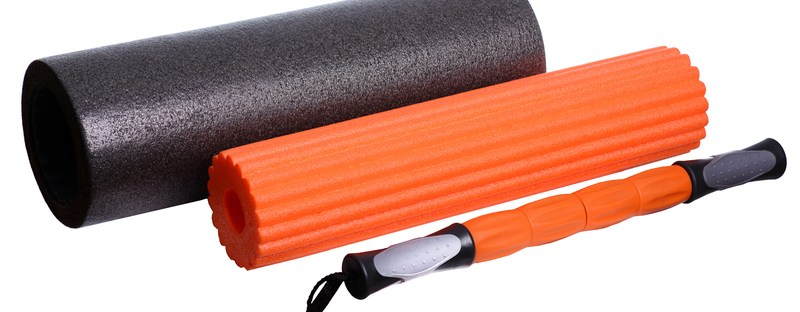
A foam roller is cylindrical in shape, and available in various sizes and densities (ie. medium, firm), the roller is positioned between the ground and the muscles to be treated. The idea is that you literally roll the muscles over the foam-roller at an even tempo, back and forth, and work on any tightness – at your own pace and in your own time. Foam-rolling is often referred to as a form of ‘self-myofascial release therapy’. Fascia, or myofascia, is the dense, tough tissue that surrounds and covers all of your muscles and bones. Foam-rolling is a form of self-manual therapy which aims to reduce myofascial tightness.

What are the Benefits of Foam Rolling?

Foam Rolling is used by many for the following reasons that have been shown in research (keep in mind a PubMed search with leaner criteria than normal for me only gave me 40 papers, then from those I picked out about 11 to create this post)

  • Increased flexibility, including increased range-of-motion (ROM)1-4
  • Improved short-term athletic performance, when included as part of the warm-up routine5-8
  • Improved recovery post-activity, through reducing the experience of delayed-onset-of-muscular-soreness (DOMS)8-10

What is the Optimal Protocol to Maintain the Benefits?

After reviewing the current body of research, the following protocol is suggested for potentially optimal results:

  • 3-5 sets of 20-30 second repetitions
  • 3-5 times per week, performed on a consistent basis, to achieve and retain the long-term effects on flexibility.

I prefer a little less time, which is the suggestion on the video I posted with 3-5 sec, counting “1-Missippi, 2-Missippo, etc” for 5-10 repetitions just because that seems to work for me best.

Risks to Foam Rolling

              I would be doing you in justice if I did not mention the risks of foam rolling. With that said, here are the following basics to make sure you are aware of since foam rollers are intended to be used over muscles only:

  • You should never roll over a bony joint. Applying pressure here could result in hyper-extension of your joints. It’s good to get close to the attachment of the joints, but best not to go over them.
  • Avoid rolling your lower back, as it can create too much pressure on your vertebra, causing the muscles here to stiffen up to protect your lower back.
  • Don’t roll for too long. You don’t want to cause further inflammation by over doing the rolling. Follow the above-mentioned program for best results.

IT Band and the Foam Roller

IT Band, or iliotibial band, is a thick tendon that runs along the outside of the thigh from the hip to the knee. Your glutes and tensor fascia latte (TFL), connect to the IT Band, and together help to move the hip and stabilize the knee. Studies have shown so far that it probably can’t be permanently deformed.  While it may be stretched in the short term this is due to its viscoelastic properties, the IT Band cannot actually permanently be lengthened with stretching.  Actual lengthening would require you to damage your IT Band to get it into a lengthened state (ie: surgical lengthening). Studies have shown 5 minutes on a foam roller or 10 minutes of daily stretching would not be able to permanent lengthening.11  The best idea is to foam roll the muscles that surround the IT band, particularly the quads, hamstrings and glutes. The IT band may be forced to compensate and pick up the slack if these muscles aren’t functioning properly. The result is an overworked and inflamed IT band—one that’s more likely to cause problems. Foam rolling the areas around the IT band helps the muscles and tendons. Studies show that you can roll of the IT Band but not for long, consider on 5-8sec, 1-3 reps, on each side only, and AFTER rolling the glutes, quads, and TFL areas.

Best Type of Foam Roller

              I do not support any 1 particular product brand (unless a brand wants to show me otherwise) but make sure of the following:

  • Foam rollers with a smaller diameter are also helpful for elderly patients who need to be closer to the ground for stability.
  • Half-round foam rollers are a good choice for an elderly person or someone with little strength or muscle tone
  • Select a 12-inch (30 cm) round roller if you intend to transport your roller often (I have a 12inch and a 36 inch- which you saw in the video)
  • A lower density foam roller is great for beginners (usually the white foam rollers)
  • A foam roller with a dimpled surface will give a deeper massage to trigger points in the muscles. This type of roller is great for parts of the body that are prone to muscle tightness, like the back and shoulders. FYI – Can be painful and he 3-5sec rule may be best to follow at first, like I teach on my videos

Precaution and Learning

              If you are not sure how to start, which roller to start with, or simply want help at first, then consult with a healthcare provider to help you in the beginning! There is nothing wrong with asking first and then trying it out. I ask all the time how to do something properly if I don’t know how to do or use something.

References:

  1. Jay, K., Sundstrup, E., Søndergaard, S. D., Behm, D., Brandt, M., Særvoll, C. A., & Andersen, L. L. (2014). Specific and cross over effects of massage for muscle soreness: randomized controlled trial. International journal of sports physical therapy, 9(1), 82-91.
  2. Cheatham SW, Kolber MJ, Cain M, Lee M. The effects of self-myofascial release using a foam roller or roller massager on joint range of motion, muscle recovery, and performance: a systematic review. Int J Sports Phys Ther. 2015 Nov;10(6):827-38.
  3. Halperin, I., Aboodarda, S. J., Button, D. C., Andersen, L. L., & Behm, D. G. (2014). Roller massager improves range of motion of plantar flexor muscles without subsequent decreases in force parameters. International journal of sports physical therapy, 9(1), 92.
  4. MacDonald, G. Z., Penney, M. D., Mullaley, M. E., Cuconato, A. L., Drake, C. D., Behm, D. G., & Button, D. C. (2013). An acute bout of self-myofascial release increases range of motion without a subsequent decrease in muscle activation or force. The Journal of Strength & Conditioning Research, 27(3), 812-821.
  5. Cramer JT, Housh TJ, Weir JP, Johnson GO, Coburn JW, Beck TW (2005). The acute effects of static stretching on peak torque, mean power output, electromyography, and mechanomyography. Eur J Appl Physiol.;93(5- 6):530–9.
  6. Cramer JT, Housh TJ, Coburn JW, Beck TW, Johnson GO (2006). Acute effects of static stretching on maximal eccentric torque production in women. J Strength Cond Res.;20(2):354–8.
  7. Behm DG, Bambury A, Cahill F, Power K (2004). Effect of acute static stretching on force, balance, reaction time, and movement time. Med Sci Sports Exerc. Aug; 36(8):1397–402.
  8. Healey, K. C., Hatfield, D. L., Blanpied, P., Dorfman, L. R., & Riebe, D. (2014). The effects of myofascial release with foam rolling on performance. The Journal of Strength & Conditioning Research, 28(1), 61-68.
  9. Peacock CA, Krein DD, Silver TA, Sanders GJ, VON Carlowitz KA (2014). An Acute Bout of Self-Myofascial Release in the Form of Foam Rolling Improves Performance Testing. Int J Exerc Sci.,1;7(3):202-211.
  10. Pearcey, G.E., Bradbury-Squires, D.J., Kawamoto, J.E., Drinkwater, E.J., Behm, D.G., and Button, D.C. (2015). Foam rolling for delayed-onset muscle soreness and recovery of dynamic performance measures. Journal of Athletic Training, 50(1): 5-15.
  11. Hall M, Chadwick Smith J. THE EFFECTS OF AN ACUTE BOUT OF FOAM ROLLING ON HIP RANGE OF MOTION ON DIFFERENT TISSUES. Int J Sports Phys Ther. 2018;13(4):652-660.
Exercise

The Art of Indoor Cycling

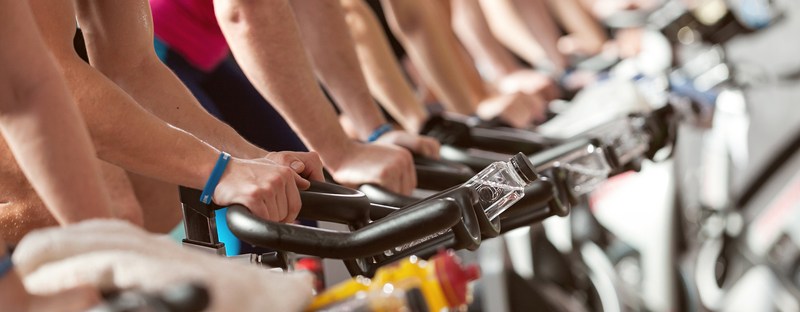
There is more to indoor cycling than just jumping on the bike and pedaling. It is a fantastic workout! I can take a class through a great leg workout, which includes those glutes, as well as a cardio workout. However, there are several things to consider prior to just jumping on the bike!

Posture and Proper Set-up Prior to Starting a Ride

Align your upper body properly to start with on the bike. Your spine should be straight, not rounded or slumped (make sure your handlebars are high enough so you don’t feel neck or back strain). Your shoulders should be relaxed and down (meaning: they should not be at your ears). Keep a slight bend in your elbows as you ride and keep your elbows in line with your wrists and your knees (no chicken-winging allowed). If you are good at angles, then aim for about 15 degrees of elbow bend. Try not to bend your wrists too much, to avoid placing unnecessary strain on them, and don’t grip the handlebars too tightly.

The placement of your bottom should be proper as well. This will help that soreness you may experience at the first couple of classes. Place your butt on the widest part of the saddle. Hinge forward at the hips and engage your abdominal muscles as you reach for the handlebars. Your knees should be aligned with your hips and your feet, whether you’re riding in a seated or in a standing position; if they flare out to the side, your seat position may need to be adjusted. If your butt is uncomfortable or sore after your workout, your positioning may be incorrect. Ask your instructor for some assistance before class if you are having issues. If you feel pain in the back of your knee, then you may need to lower the seat. If you feel pain the front of your knee, then consider raising the seat. The knee should have a 5-degree bend when the leg is fully extended down.

During Your Ride

Keep your weight on the pedals. That means stabilizing your weight in your hips so that your knees stay over the center of the pedals. Don’t lean on the handlebars when you’re seated or standing; off-loading your weight this way cheats you of some of the benefits you’d get from maintaining an upright posture and it places excessive stress on the wrists and forearms. (When you’re in a standing position, you should feel the nose of the saddle brushing against the back of your upper thighs.) Also, avoid using hand position three while riding in the saddle—a taboo move! If your instructor does it, then let them, but I wouldn’t do it!

Keep your feet flat. It’s a mistake to point your toes as you pedal because this engages the wrong muscles. Instead, press through each pedal stroke with a flat foot, driving from the ball of your foot, to reduce pressure on your knees and strain on your quads. Similarly, pull up from your knees and toes on the upstroke. This will engage the hamstrings and glutes for a nice leg workout. It is more efficient way to use your muscles too.

Hold your head up. If you let your head flop or fall forward as you ride, you’ll set yourself up for neck strain—and partially impair the flow of blood and oxygen to your head, which can cause lightheadedness or dizziness. Keeping your head in line with your neck and spine helps ensure proper breathing and a steady flow of oxygen to your brain, which can help you feel good and maximize your performance. An indoor cycling class is hard enough without increasing your chances of feeling winded unnecessarily.  And I can’t stress enough – lose grip on the handle bars…..of you are sore in the forearms, upper body the next day, chances are you gripped the handle bars too tight.

After You Ride

Make sure to keep spinning the legs for 1-2 minutes to slow down the heart rate properly. If you wear biking shoes, be sure to unclip them while standing, so you don’t put unnecessary pressure on your hips and knees. Then take 4-6 minutes (I make my class do a full song) to stretch the upper and lower body. Give your major muscle groups a good stretch after class.

Exercise, Uncategorized

What Is the Best Running Form?

After my last post I had several people want to write about running form. I have been asked as a running coach time and time again, “how do you run?” It might seem odd to some to think there is a “ideal running form” but having proper biomechanics helps! Running starts with practicing your form so that you are more efficient by using muscles groups appropriately, while resting others. So here is the quick and dirty on running form from head to toe! Below is referenced from Runner’s World Author in 2005, JANE UNGER HAHN with a little added tip or two from myself.

Head – How you hold your head is key to overall posture, which determines how efficiently you run. Let your gaze guide you. Look ahead naturally, not down at your feet, and scan the horizon. I like to focus on powerlines out in front of me or tree lines/streetlamps. This will straighten your neck and back and bring them into alignment. Don’t allow your chin to jut out.

Shoulders – Shoulders play an important role in keeping your upper body relaxed while you run, which is critical to maintaining efficient running posture. For optimum performance, your shoulders should be low and loose, not high and tight. As you tire on a run, don’t let them creep up toward your ears. If they do, shake them out to release the tension. I will literally drop my arms and shake them out! Your shoulders also need to remain level and shouldn’t dip from side to side with each stride.

Arms – Even though running is primarily a lower-body activity, your arms aren’t just along for the ride. Your hands control the tension in your upper body, while your arm swing works in conjunction with your leg stride to drive you forward. Keep your hands in an unclenched fist, with your fingers lightly touching your palms. Imagine yourself trying to carry a potato chip in each hand without crushing it (I use to make some of my runners carry potato chips and not crush them). Your arms should swing mostly forward and back, not across your body, between waist and lower-chest level. Your elbows should be bent at about a 90-degree angle. When you feel your fists clenching or your forearms tensing, drop your arms to your sides and shake them out for a few seconds to release the tension.  Basically, like putting something in your pockets!

Torso – The position of your torso while running is affected by the position of your head and shoulders. With your head up and looking ahead and your shoulders low and loose, your torso and back naturally straighten to allow you to run in an efficient, upright position that promotes optimal lung capacity and stride length. Many track coaches describe this ideal torso position as “running tall” and it means you need to stretch yourself up to your full height with your back comfortably straight. If you start to slouch during a run, take a deep breath and feel yourself naturally straighten. As you exhale simply maintain that upright position.

Hips – Your hips are your center of gravity, so they’re key to good running posture. The proper position of your torso while running helps to ensure your hips will also be in the ideal position. With your torso and back comfortably upright and straight, your hips naturally fall into proper alignment–pointing you straight ahead. If you allow your torso to hunch over or lean too far forward during a run, your pelvis will tilt forward as well, which can put pressure on your lower back and throw the rest of your lower body out of alignment. When trying to gauge the position of your hips, think of your pelvis as a bowl filled with marbles, then try not to spill the marbles by tilting the bowl.

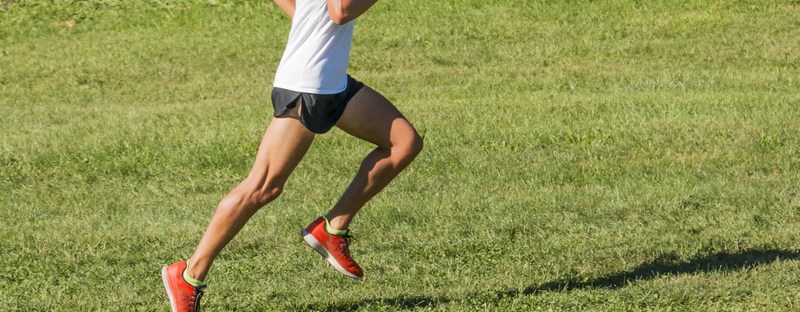
Legs/Stride – While sprinters need to lift their knees high to achieve maximum leg power, distance runners don’t need such an exaggerated knee lift–it’s simply too hard to sustain for any length of time. Instead, efficient endurance running requires just a slight knee lift, a quick leg turnover, and a short stride. Together, these will facilitate fluid forward movement instead of diverting (and wasting) energy. When running with the proper stride length, your feet should land directly underneath your body. As your foot strikes the ground, your knee should be slightly flexed so that it can bend naturally on impact. REMEMBER, running midfoot to toe is better for longer distance than trying to run on your toes constantly. If your lower leg (below the knee) extends out in front of your body, your stride is too long.

Ankles/Feet To run well, you need to push off the ground with maximum force. With each step, your foot should hit the ground lightly–landing between your heel and midfoot–then quickly roll forward. Keep your ankle flexed as your foot rolls forward to create more force for push-off. As you roll onto your toes, try to spring off the ground. You should feel your calf muscles propelling you forward on each step. Your feet should not slap loudly as they hit the ground. Good running is springy and quiet.

Breathing – The most difficult part is something I say to each class — Make a beat with your feet and breathe to the rhythm. Don’t be too loud on your feet and still follow the proper form above but try to over-exaggerate at first until you find that rhythm with breathing. I have people try multiple ways to see how the breathing works best. For instance, try for every step, one breath in and one out, or two in and two out, or two in and one long breath out.


Let me know how it goes!

Exercise

Get The Most Out of Your Time With Different Types of Running Techniques to Improve Speed and Distance

Easy (Aerobic) Run:

This should be 2-3 min slower than your normal race pace per mile.  This is the type of workout that would be used to increase your aerobic (lung and heart) endurance and help to increase mileage. A person would not push too hard, so you should be able to carry on a light (very light) conversation but add extra miles to the run for that day. Side Note– This would be ideal with a group of friends, any time of the day, well hydrated, and choose to eat if it works for you. I don’t eat before running. Other people I have coached for races prefer to eat prior. The time to eat would be about 30-60 minutes prior to activity and nothing too high in fiber or fat, so your digestive system isn’t miserable while you are running!

Race Pace:

This is self-explanatory, but for the heck of it, it is the run that you do that is the same pace per mile as you would do for a race.  For most people, this means pushing yourself a little more, to the point of no conversation.  This type of training is utilized during the week for increasing your lactate threshold (Lactate threshold is defined as the intensity of exercise at which lactate begins to accumulate in the blood at a faster rate than it can be removed) to a certain extent, while still improving your aerobic capacity. Side Note– You might hate this one before and during (I admit I loathe it), but after you feel amazing (“runner’s high” typically experienced). Each time will get easier as well! You might not want friends with you on this one, unless you find them motivating?? (or you just want to secretly beat them without them knowing 😊

Tempo Run:

A tempo run is a fast, no conversation type of run that pushes you to the next limit. It helps anaerobic, aerobic, and your lactate threshold.  A person should incorporate these types of workouts at least once a week.  It helps to increase speed as well.  Most people say that a tempo run should be 20-30 seconds slower than your race pace per mile; however, some people argue that it should be 20-30 seconds faster than race pace per mile. Tempo runs help increase your VO2Max (your body’s ability to take in oxygen and use it to make energy in the muscle). Continued use of tempo runs signals your body to make more capillaries in the muscle. More capillaries means more oxygenated blood getting to the muscle. The distance of tempo runs can vary, but 4-8 miles is a good range. If you’re new to tempos, start with a shorter distance and work your way up! Side Note– Again, it is hard to make yourself do these but after you will be happy you did, especially after 3-4 weeks of training and you see the difference, both in your running workouts and possible toned legs, abs, and overall body image!

Hill Sprints (Fartlek Training-Swedish for “speed play”):

This type of workout helps to push you in a more even anaerobic and aerobic workout. The uphill is a sprint, utilizing the anaerobic capacity and increasing leg endurance, while the downhill is increasing your recovery time, aerobically, while allowing the legs to recover. The downhill can be a walk to an easy jog. This kind of workout can be as long as you want it, as long as a person is not slowing down or losing energy during the workout. Side Note – Live in Florida like me?? Great News!! By training through summer, we are simulating the effects of running at altitude. Running “at altitude,” or at elevations generally higher than 5,000 feet above sea level, is much harder because there’s not as much oxygen in the air. At altitudes higher than 5,000 feet (like Denver, CO), your cardiovascular system must work harder to run the same pace that would normally have been easier for you at sea level. There’s simply less oxygen in the air and your heart must beat faster to pump more blood to your working muscles. After you acclimatize to higher elevations, your body produces more red blood cells. These cells transport oxygen to your muscles. Heat training can provide similar benefits. Running when it’s hot and humid won’t force your body to produce more red blood cells, but a host of other biochemical changes occur that make you more efficient! Woot-Woot!

Anaerobic Intervals:

This is strictly an anaerobic workout, which helps to increase speed and muscular endurance. When times are limited during the week, either a hill sprint or an interval workout will suffice.  With these types of workouts, a person would want to do 2 -2.5 min bouts of sprints, followed by a 1-2 min walk or jog, and no longer than 20-30 minutes.  It is a fantastic way to change things up and “trick” your body during training for speed. Side Note – Hit the Track!  A simple workout à Ladder Workout is my fave to start with the first couple of times. Warm-up 1 mile, 200m, 60-90min recovery walk/jog, 400m, then recovery, 600m, then recovery, 800m, recovery, 1000m then recovery, then back down the “ladder”, repeating 1000m, then 800m, 600m, 400m, 200m, with recovery between each sprint 😉 Enjoy!

All of these workouts come together to help build an overall improvement for speed, endurance, strength, and recovery. You must have all of them to be balanced and hopefully reduce injury! I enjoy 3-4 running workouts like this a week, since I prefer running and enjoy racing, not just lifting! On other days for cardio I do cycling, walking, rowing, and stair stepper at the gym. And as always, you should consult your primary care provider prior to starting a workout regimen, to make sure all is safe! Happy Running!