
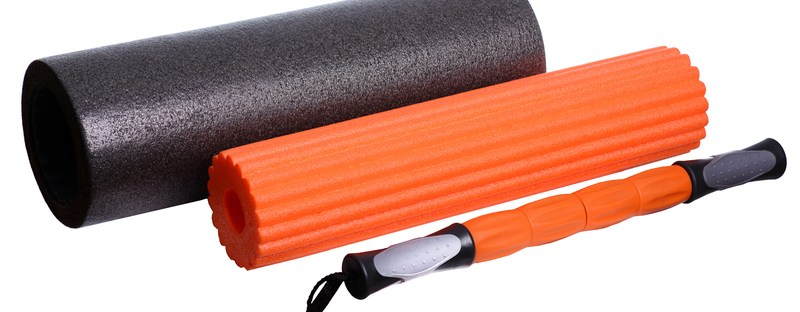
What is a Foam Roller/Rolling?
A foam roller is cylindrical in shape, and available in various sizes and densities (ie. medium, firm), the roller is positioned between the ground and the muscles to be treated. The idea is that you literally roll the muscles over the foam-roller at an even tempo, back and forth, and work on any tightness – at your own pace and in your own time. Foam-rolling is often referred to as a form of ‘self-myofascial release therapy’. Fascia, or myofascia, is the dense, tough tissue that surrounds and covers all of your muscles and bones. Foam-rolling is a form of self-manual therapy which aims to reduce myofascial tightness.
What are the Benefits of Foam Rolling?
Foam Rolling is used by many for the following reasons that have been shown in research (keep in mind a PubMed search with leaner criteria than normal for me only gave me 40 papers, then from those I picked out about 11 to create this post)
- Increased flexibility, including increased range-of-motion (ROM)1-4
- Improved short-term athletic performance, when included as part of the warm-up routine5-8
- Improved recovery post-activity, through reducing the experience of delayed-onset-of-muscular-soreness (DOMS)8-10
What is the Optimal Protocol to Maintain the Benefits?
After reviewing the current body of research, the following protocol is suggested for potentially optimal results:
- 3-5 sets of 20-30 second repetitions
- 3-5 times per week, performed on a consistent basis, to achieve and retain the long-term effects on flexibility.
I prefer a little less time, which is the suggestion on the video I posted with 3-5 sec, counting “1-Missippi, 2-Missippo, etc” for 5-10 repetitions just because that seems to work for me best.
Risks to Foam Rolling
I would be doing you in justice if I did not mention the risks of foam rolling. With that said, here are the following basics to make sure you are aware of since foam rollers are intended to be used over muscles only:
- You should never roll over a bony joint. Applying pressure here could result in hyper-extension of your joints. It’s good to get close to the attachment of the joints, but best not to go over them.
- Avoid rolling your lower back, as it can create too much pressure on your vertebra, causing the muscles here to stiffen up to protect your lower back.
- Don’t roll for too long. You don’t want to cause further inflammation by over doing the rolling. Follow the above-mentioned program for best results.
IT Band and the Foam Roller
IT Band, or iliotibial band, is a thick tendon that runs along the outside of the thigh from the hip to the knee. Your glutes and tensor fascia latte (TFL), connect to the IT Band, and together help to move the hip and stabilize the knee. Studies have shown so far that it probably can’t be permanently deformed. While it may be stretched in the short term this is due to its viscoelastic properties, the IT Band cannot actually permanently be lengthened with stretching. Actual lengthening would require you to damage your IT Band to get it into a lengthened state (ie: surgical lengthening). Studies have shown 5 minutes on a foam roller or 10 minutes of daily stretching would not be able to permanent lengthening.11 The best idea is to foam roll the muscles that surround the IT band, particularly the quads, hamstrings and glutes. The IT band may be forced to compensate and pick up the slack if these muscles aren’t functioning properly. The result is an overworked and inflamed IT band—one that’s more likely to cause problems. Foam rolling the areas around the IT band helps the muscles and tendons. Studies show that you can roll of the IT Band but not for long, consider on 5-8sec, 1-3 reps, on each side only, and AFTER rolling the glutes, quads, and TFL areas.
Best Type of Foam Roller
I do not support any 1 particular product brand (unless a brand wants to show me otherwise) but make sure of the following:
- Foam rollers with a smaller diameter are also helpful for elderly patients who need to be closer to the ground for stability.
- Half-round foam rollers are a good choice for an elderly person or someone with little strength or muscle tone
- Select a 12-inch (30 cm) round roller if you intend to transport your roller often (I have a 12inch and a 36 inch- which you saw in the video)
- A lower density foam roller is great for beginners (usually the white foam rollers)
- A foam roller with a dimpled surface will give a deeper massage to trigger points in the muscles. This type of roller is great for parts of the body that are prone to muscle tightness, like the back and shoulders. FYI – Can be painful and he 3-5sec rule may be best to follow at first, like I teach on my videos
Precaution and Learning
If you are not sure how to start, which roller to start with, or simply want help at first, then consult with a healthcare provider to help you in the beginning! There is nothing wrong with asking first and then trying it out. I ask all the time how to do something properly if I don’t know how to do or use something.
References:
- Jay, K., Sundstrup, E., Søndergaard, S. D., Behm, D., Brandt, M., Særvoll, C. A., & Andersen, L. L. (2014). Specific and cross over effects of massage for muscle soreness: randomized controlled trial. International journal of sports physical therapy, 9(1), 82-91.
- Cheatham SW, Kolber MJ, Cain M, Lee M. The effects of self-myofascial release using a foam roller or roller massager on joint range of motion, muscle recovery, and performance: a systematic review. Int J Sports Phys Ther. 2015 Nov;10(6):827-38.
- Halperin, I., Aboodarda, S. J., Button, D. C., Andersen, L. L., & Behm, D. G. (2014). Roller massager improves range of motion of plantar flexor muscles without subsequent decreases in force parameters. International journal of sports physical therapy, 9(1), 92.
- MacDonald, G. Z., Penney, M. D., Mullaley, M. E., Cuconato, A. L., Drake, C. D., Behm, D. G., & Button, D. C. (2013). An acute bout of self-myofascial release increases range of motion without a subsequent decrease in muscle activation or force. The Journal of Strength & Conditioning Research, 27(3), 812-821.
- Cramer JT, Housh TJ, Weir JP, Johnson GO, Coburn JW, Beck TW (2005). The acute effects of static stretching on peak torque, mean power output, electromyography, and mechanomyography. Eur J Appl Physiol.;93(5- 6):530–9.
- Cramer JT, Housh TJ, Coburn JW, Beck TW, Johnson GO (2006). Acute effects of static stretching on maximal eccentric torque production in women. J Strength Cond Res.;20(2):354–8.
- Behm DG, Bambury A, Cahill F, Power K (2004). Effect of acute static stretching on force, balance, reaction time, and movement time. Med Sci Sports Exerc. Aug; 36(8):1397–402.
- Healey, K. C., Hatfield, D. L., Blanpied, P., Dorfman, L. R., & Riebe, D. (2014). The effects of myofascial release with foam rolling on performance. The Journal of Strength & Conditioning Research, 28(1), 61-68.
- Peacock CA, Krein DD, Silver TA, Sanders GJ, VON Carlowitz KA (2014). An Acute Bout of Self-Myofascial Release in the Form of Foam Rolling Improves Performance Testing. Int J Exerc Sci.,1;7(3):202-211.
- Pearcey, G.E., Bradbury-Squires, D.J., Kawamoto, J.E., Drinkwater, E.J., Behm, D.G., and Button, D.C. (2015). Foam rolling for delayed-onset muscle soreness and recovery of dynamic performance measures. Journal of Athletic Training, 50(1): 5-15.
- Hall M, Chadwick Smith J. THE EFFECTS OF AN ACUTE BOUT OF FOAM ROLLING ON HIP RANGE OF MOTION ON DIFFERENT TISSUES. Int J Sports Phys Ther. 2018;13(4):652-660.

 Healthy, Fit, & Busy - OH MY